
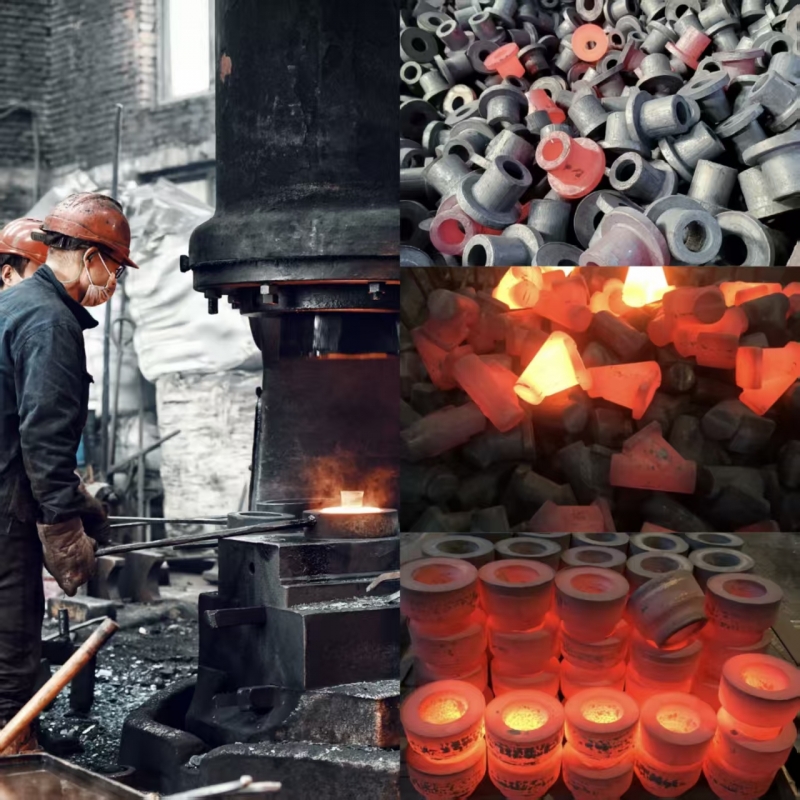
What are the precision forging processes?
There are many precision forging processes currently applied in production, which can be divided into hot precision forging, cold precision forging, warm precision forging, composite precision forging, isothermal precision forging, etc. according to different forming temperatures.
1. Hot precision forging process
The precision forging process with a forging temperature above the recrystallization temperature is called hot precision forging. Hot precision forging materials have low deformation resistance, good plasticity, and are easy to form complex workpieces. However, due to strong oxidation, the surface quality and dimensional accuracy of the workpiece are low. The commonly used process for hot precision forging is closed die forging.
2. Cold precision forging process
Cold precision forging is a precision forging process carried out at room temperature. The cold precision forging process has the following characteristics: the shape and size of the workpiece are easy to control, avoiding errors caused by high temperatures, the workpiece strength and accuracy are high, the surface quality is good, the cold forging forming process is tight, the workpiece plasticity is poor, the deformation resistance is large, the requirements for molds and equipment are high, and it is difficult to form parts with complex structures.
3. Warm precision forging process
Warm precision forging is a precision forging process carried out at a suitable temperature below the recrystallization temperature. Warm precision forming technology not only breaks through the limitations of high deformation resistance, less complex part shape, and the need for additional intermediate heat treatment and surface treatment steps in cold forging, but also overcomes the problem of reduced surface quality and dimensional accuracy due to strong oxidation in hot forging. It has the advantages of both cold forging and hot forging, overcoming their disadvantages.
4. Composite precision forging process
With the increasing complexity and precision requirements of precision forged workpieces, simple cold, warm, and hot forging processes can no longer meet the requirements. The composite precision forging process combines cold, overflow, and hot forging processes to complete the forging of a workpiece, which can leverage the advantages of cold, warm, and hot forging and eliminate the disadvantages of cold, warm, and hot forging.
5. Isothermal precision forging process
Isothermal precision forging refers to the forging of billets at a constant temperature. Isothermal forging is commonly used for precision forming of difficult to deform materials such as titanium alloys, aluminum alloys, and magnesium alloys in the aerospace industry. In recent years, it has also been used for precision forming of non-ferrous metals in the automotive and mechanical industries. Isothermal forging is mainly applied to forging metal materials with narrow temperatures, especially titanium alloys that are very sensitive to deformation temperatures.
Warmly welcome global new and old customers to consult and cooperate with us!
Ningbo Weishi Machinery Manufacturing Co., Ltd.
 Send Email
 Joseph
 184731149
 Joseph